

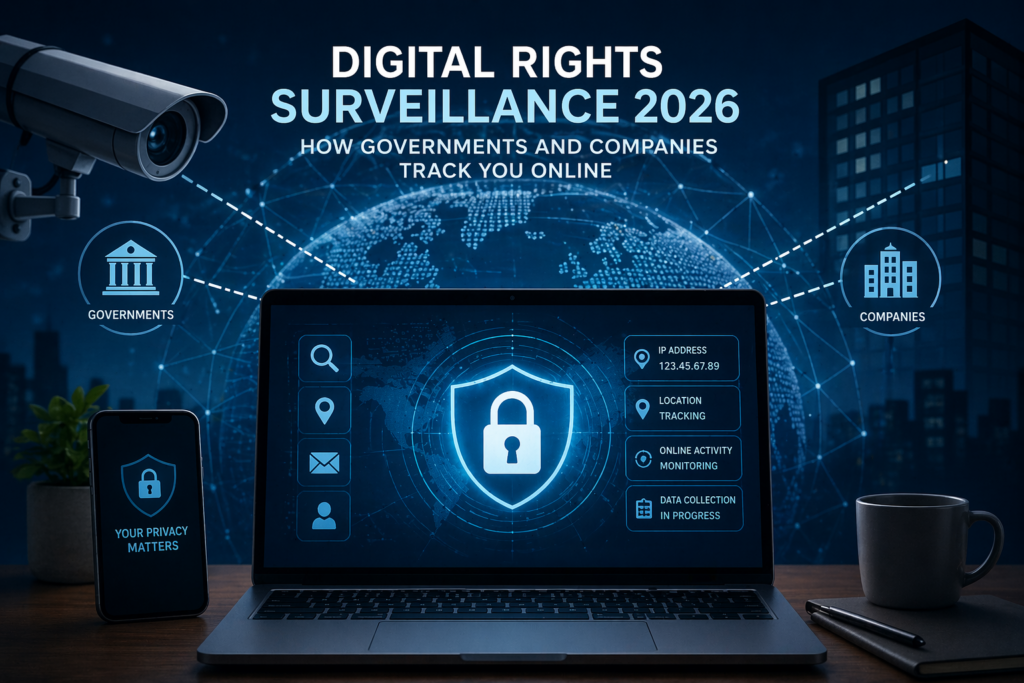
Digital Rights and Surveillance in 2026: How Governments and Companies Track You Online
Digital rights surveillance 2026 is no longer a distant concern — it is a daily reality. Every click, search, message, and movement online can be tracked, analyzed, and stored. From governments monitoring national security threats to corporations collecting data for profit, digital surveillance has become one of the defining issues of the modern internet.
In 2026, understanding how surveillance works is essential to protecting your online privacy, freedom of expression, and access to information. Digital rights are directly connected to how much control you have over your own data — and who else can access it.
What Is Digital Surveillance?
Digital surveillance refers to the monitoring, collection, and analysis of user data online. This can include:
- Browsing history
- Search queries
- Location data
- Messages and emails
- Social media activity
- Device information
Surveillance is carried out by multiple actors, including governments, internet service providers (ISPs), and large technology companies. While some forms of monitoring are legal and intended for security, others raise serious concerns about privacy and abuse of power.
According to the Electronic Frontier Foundation (EFF), modern surveillance systems are capable of collecting vast amounts of personal data without users fully understanding how their information is being used.
Why Digital Rights Surveillance Matters in 2026
The rise of digital rights surveillance 2026 has changed how people interact with the internet. What was once an open space for free communication is now increasingly shaped by monitoring systems and algorithms.
This has direct consequences for:
- Freedom of speech – People may censor themselves if they feel they are being watched
- Privacy – Personal data is constantly collected and stored
- Access to information – Content can be filtered or restricted
- Security – Data breaches and misuse of information are growing risks
Organizations like Freedom House report that internet freedom has declined globally over the past decade, largely due to increased surveillance and censorship practices.
Government Surveillance vs Corporate Surveillance
To understand digital rights in 2026, it is important to distinguish between two main types of surveillance:
1. Government Surveillance
Governments use surveillance tools to monitor citizens for reasons such as national security, crime prevention, and political control. This can include:
- Mass data collection programs
- Monitoring internet traffic through ISPs
- Tracking social media activity
- Using facial recognition and AI systems
While some surveillance is justified for security, excessive monitoring can lead to violations of civil liberties and human rights.
The Amnesty International campaign against biometric surveillance highlights the risks of unchecked government tracking technologies.
2. Corporate Surveillance
Large technology companies collect user data to improve services, personalize content, and generate revenue through advertising. This type of surveillance includes:
- Tracking user behavior across websites
- Collecting data through apps and devices
- Analyzing user preferences and habits
- Building detailed user profiles
Companies like Google, Meta, and others rely heavily on data collection as part of their business model. While this enables free services, it also raises serious concerns about how much data is being collected and who has access to it.
You can learn more about how governments restrict and monitor internet access in our related guide:
How to Bypass Internet Censorship Safely
Real-World Examples of Surveillance in Action
Digital surveillance is not theoretical — it is already happening worldwide. Some examples include:
- Countries using deep packet inspection (DPI) to monitor internet traffic
- Social media platforms tracking user engagement and behavior
- Mobile apps collecting location data even when not in use
- Smart devices (IoT) recording user activity in homes
Research from Privacy International shows that many everyday apps collect far more data than users expect, often without clear consent.
This growing ecosystem of surveillance technologies makes it increasingly difficult for individuals to maintain true online privacy.
The Shift Toward a Monitored Internet
The internet in 2026 is no longer a completely open and anonymous space. Instead, it is becoming a monitored environment where data is constantly collected and analyzed.
This shift raises important questions:
- Who controls your data?
- How is your information being used?
- Can you truly remain anonymous online?
These questions are at the core of digital rights surveillance 2026 — and they will define the future of the internet.
In the next section, we will explore how online tracking actually works, including cookies, browser fingerprinting, and advanced data collection methods used by both governments and corporations.
How Online Tracking Works in 2026
To fully understand digital rights surveillance 2026, you need to know how tracking actually works. Most users underestimate how advanced modern tracking technologies have become. Today, surveillance is not limited to simple cookies — it involves complex systems designed to identify, monitor, and profile users across the entire internet.
Tracking happens on multiple levels simultaneously, often without your knowledge or explicit consent.
1. Cookies and Basic Tracking
Cookies are small files stored in your browser that track your activity across websites. While some cookies are necessary for functionality, others are used for advertising and data collection.
- Session cookies (temporary)
- Persistent cookies (long-term tracking)
- Third-party cookies (tracking across multiple websites)
Although browsers have started limiting third-party cookies, they are still widely used. According to Mozilla, cookies remain one of the most common tracking tools on the web.
2. Browser Fingerprinting
Even if you block cookies, you can still be tracked using browser fingerprinting. This technique collects unique information about your device, such as:
- Screen resolution
- Installed fonts
- Browser version
- Operating system
- Time zone and language
All of this data is combined to create a unique “fingerprint” that can identify you without needing cookies.
Research by the EFF Cover Your Tracks project shows that most users can be uniquely identified using fingerprinting techniques alone.
3. ISP and Network-Level Monitoring
Your Internet Service Provider (ISP) has access to a large portion of your online activity. Even when websites use HTTPS encryption, ISPs can still see:
- Which websites you visit
- How often you visit them
- How much data you use
In some countries, ISPs are required to store user data for extended periods and may share it with government agencies.
This is one of the reasons why tools like VPNs are commonly used. If you want to understand how to bypass restrictions and reduce tracking, check our guide:
How to Bypass Internet Censorship Safely
4. App and Mobile Tracking
Smartphones are one of the biggest sources of personal data. Apps often collect:
- Location data (GPS)
- Contacts and call logs
- Device identifiers
- Usage behavior
Even when apps are not actively in use, they may still collect background data.
A report by Apple Privacy highlights how apps request extensive permissions that many users approve without understanding the consequences.
5. Big Tech Data Ecosystems
Large technology companies operate complex ecosystems where data from multiple services is combined. For example:
- Search data
- Email content (metadata)
- Video viewing habits
- Location history
This allows companies to build detailed behavioral profiles of users.
According to Google’s Privacy Policy, data is used to personalize services, improve performance, and deliver targeted advertising.
The Risks of Constant Tracking
The expansion of digital rights surveillance 2026 creates serious risks that go beyond simple privacy concerns.
1. Loss of Privacy
When your activity is constantly monitored, true privacy becomes almost impossible. Even seemingly harmless data can reveal sensitive information about your habits, beliefs, and identity.
2. Manipulation and Control
Tracking data is often used to influence behavior. This includes:
- Personalized advertising
- Content recommendations
- Political messaging
This creates so-called “filter bubbles,” where users only see content that reinforces their existing views.
The Brookings Institution has studied how algorithmic filtering can shape public opinion and limit exposure to diverse perspectives.
3. Data Breaches and Security Risks
The more data is collected, the more attractive it becomes to hackers. Large-scale data breaches have exposed millions of user records in recent years.
According to IBM Security, the average cost of a data breach continues to rise, highlighting the risks associated with storing massive amounts of personal data.
4. Chilling Effect on Freedom
One of the most concerning effects of surveillance is the “chilling effect.” When people know they are being monitored, they may:
- Avoid expressing controversial opinions
- Limit their online activity
- Self-censor their behavior
This directly impacts freedom of expression, which is a core element of digital rights.
The Future of Tracking Technologies
Tracking technologies are evolving rapidly. In the coming years, we can expect:
- AI-driven surveillance systems
- More advanced biometric tracking
- Integration of data across devices
- Greater use of predictive analytics
These developments will make it even more important to understand and defend digital rights.
In the next section, we will focus on how to protect yourself, including practical tools and strategies to reduce tracking and regain control over your online privacy.
How to Protect Your Digital Rights in 2026
Understanding digital rights surveillance 2026 is only the first step. The real challenge is protecting yourself in an environment where tracking is constant and increasingly sophisticated.
While complete anonymity is difficult to achieve, there are effective strategies and tools that can significantly reduce your exposure and help you regain control over your online privacy.
1. Use a VPN to Protect Your Internet Traffic
A Virtual Private Network (VPN) encrypts your internet connection and hides your IP address. This prevents your ISP and other third parties from easily monitoring your activity.
- Encrypts your data
- Masks your location
- Helps bypass restrictions
VPNs are one of the most accessible tools for improving privacy. However, not all VPNs are trustworthy, so it is important to choose providers with strong privacy policies.
For a deeper explanation, see our guide:
How to Bypass Internet Censorship Safely
2. Use Privacy-Focused Browsers
Standard browsers often allow tracking by default. Privacy-focused alternatives can reduce data collection:
- Firefox – strong privacy controls
- Brave – blocks trackers and ads by default
- Tor Browser – advanced anonymity
The Tor Project provides tools that help users browse anonymously by routing traffic through multiple servers.
3. Limit App Permissions
Many apps collect far more data than necessary. You should regularly review and restrict permissions such as:
- Location access
- Microphone and camera
- Contacts and storage
Reducing permissions can significantly limit how much data is collected about you.
4. Use Encrypted Communication Tools
Messaging apps can expose sensitive data if they are not secure. Use end-to-end encrypted platforms such as:
- Signal
- WhatsApp (with limitations)
- Proton Mail for email
Encryption ensures that only you and the recipient can read your messages.
The Signal Foundation is widely recognized for promoting secure communication technologies.
5. Avoid Unnecessary Data Sharing
Many platforms encourage users to share personal information. However, every piece of data increases your digital footprint.
Ask yourself:
- Do I really need to provide this information?
- Who will have access to it?
- How long will it be stored?
Minimizing data sharing is one of the simplest ways to protect your digital rights.
6. Understand Your Legal Rights
In many regions, users have legal protections regarding their data. For example:
- Right to access your data
- Right to delete personal information
- Right to restrict data processing
The General Data Protection Regulation (GDPR) in the European Union is one of the strongest privacy frameworks currently in place.
Understanding your rights allows you to take action when your data is misused.
The Future of Digital Rights and Surveillance
The relationship between digital rights and surveillance will continue to evolve. As technology advances, new challenges will emerge, including:
- AI-driven monitoring systems
- Biometric identification (face, voice, behavior)
- Smart cities with integrated surveillance
- Global data-sharing networks
These developments will require stronger regulations and greater public awareness.
Organizations like the United Nations Internet Governance Forum emphasize the importance of protecting human rights in the digital age.
Why Digital Rights Still Matter
At its core, digital rights surveillance 2026 is not just about technology — it is about power, control, and freedom.
Your ability to:
- Access information
- Express your opinions
- Communicate privately
depends on how digital systems are designed and regulated.
If surveillance continues to expand without limits, the internet risks becoming a controlled environment rather than an open platform for innovation and communication.
Final Thoughts
The internet has transformed the world, but it has also created new risks. Understanding digital rights surveillance 2026 is essential for anyone who wants to stay informed, secure, and free online.
By learning how tracking works and taking practical steps to protect yourself, you can reduce your exposure and maintain greater control over your digital life.
The future of the internet will depend on how individuals, companies, and governments respond to these challenges.
The question is no longer whether you are being tracked — but how much control you still have.
Understanding digital rights surveillance 2026 is essential in today’s connected world. As digital rights surveillance 2026 continues to expand, individuals must stay informed and proactive in protecting their online privacy.
Governments and companies rely heavily on digital rights surveillance 2026 technologies to monitor behavior, analyze data, and shape online experiences. This makes digital rights surveillance 2026 one of the most important topics in the modern digital landscape.
Submit your story here
If you have evidence of censorship, deplatforming, blocked access, or media suppression, send your article, documentation, or video-based story for review. Submit Your Story