


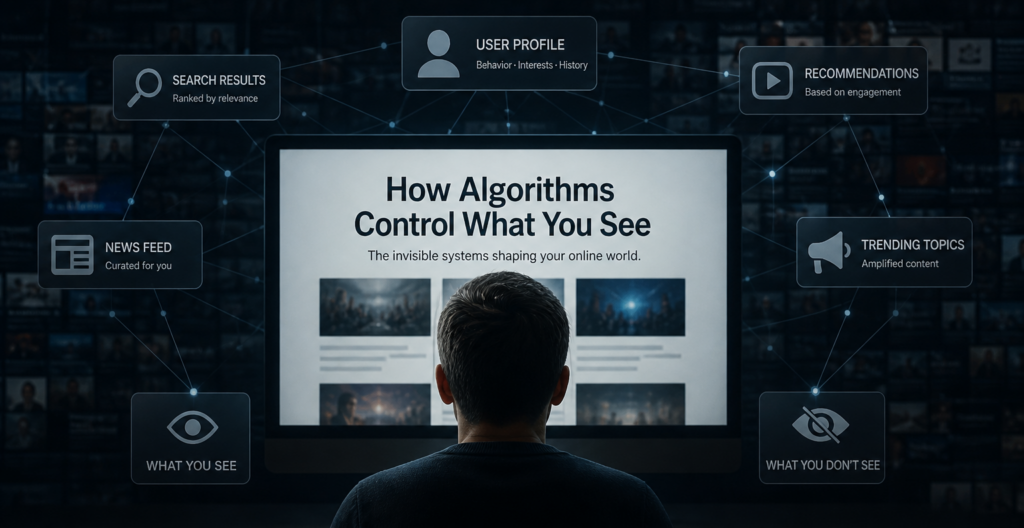
How Algorithms Quietly Control What You See Online (2026 Deep Investigation)
The internet feels open. It isn’t.
How algorithms control what you see is one of the most important forces shaping the modern internet.
Every search result, every recommendation, every video autoplaying on your screen – none of it is neutral. Behind it all, invisible systems decide what appears and what disappears. These systems are not passive tools. They are active filters shaping perception, attention, and ultimately reality.
Most people still believe they “use the internet.” In reality, the internet is using them – learning from their behavior, predicting their interests, and continuously adjusting what they see.
This investigation explores a fundamental but often ignored truth:
You do not see the internet as it is. You see the version that algorithms want you to see.
The Illusion of an Open Internet
The early internet promised decentralization and free access to information. Anyone could publish. Anyone could read. The system itself did not decide what mattered.
That era is over.
Today, most online experiences are mediated through centralized platforms – search engines, social networks, recommendation feeds. These platforms rely on algorithmic ranking systems to organize information at scale.
Without these systems, the internet would be unusable. But with them, something else happens:
Control emerges.
Not through direct censorship, but through prioritization.
Not through deletion, but through invisibility.
Research published in Nature Human Behaviour demonstrates that algorithmic filtering significantly reduces exposure to diverse viewpoints. Instead of broadening perspective, personalization narrows it.
This is the foundation of what is often called the “filter bubble” – a system where users are gradually isolated inside content ecosystems tailored to their past behavior.
Algorithms Are Not Neutral
There is a persistent myth that algorithms are objective. That they simply “show what is relevant.”
This is misleading.
Every algorithm is built around three core elements:
- The data it is trained on
- The objective it optimizes for
- The assumptions embedded by its designers
None of these are neutral.
Most major platforms optimize for engagement – clicks, watch time, interaction. This is not a design flaw. It is the business model.
The longer you stay, the more you see. The more you see, the more ads you consume.
This creates a structural bias toward:
- Emotionally charged content
- Conflict and outrage
- Simplified narratives
- Reinforcing existing beliefs
As former Google design ethicist Tristan Harris has repeatedly warned, these systems are not designed for truth or balance – they are designed to capture attention.
The Feedback Loop That Shapes Reality
Algorithmic systems do not just respond to behavior. They shape it.
Here is how the loop works:
- You engage with certain content
- The system learns from your engagement
- It shows you more of similar content
- Your perception gradually shifts
- You engage more with similar content
This loop is subtle but powerful.
Over time, it can:
- Narrow worldview
- Increase certainty in specific narratives
- Reduce exposure to opposing perspectives
Users rarely notice this shift. From their perspective, the feed simply “feels right.”
That feeling is engineered.
From Curation to Control
There is a critical difference between organizing information and controlling it.
Modern platforms operate in a space between these two functions.
They do not explicitly tell users what to think. They decide what users are able to think about.
This distinction is essential.
A 2015 study published in PNAS introduced the concept of the Search Engine Manipulation Effect (SEME), demonstrating that biased rankings can significantly influence undecided voters – without their awareness.
The key finding was not just that influence exists, but that it is:
- Invisible
- Scalable
- Difficult to detect
Unlike traditional media bias, algorithmic influence leaves no obvious trace.
Visibility Is the New Power
In the past, censorship meant removal.
Today, it often means something else:
strategic invisibility.
Content does not need to be deleted to be suppressed. It only needs to be ranked lower.
This includes practices such as:
- Downranking content in feeds
- Reducing distribution reach
- Limiting discoverability in search
Users rarely notice this. From their perspective, the content simply “isn’t there.”
This form of control is more subtle than censorship – and often more effective.
Platforms as Information Gatekeepers
A small number of companies now control a large portion of global information flow.
These include:
- Google (search + YouTube)
- Meta (Facebook, Instagram)
- TikTok (ByteDance)
- X (formerly Twitter)
Each of these platforms operates its own algorithmic ecosystem.
Each system is different. But all share one characteristic:
They decide what becomes visible at scale.
This concentration of influence raises fundamental questions about transparency, accountability, and power.
The Psychological Layer
Algorithmic systems do not operate in isolation. They interact with human psychology.
Research from MIT found that false information spreads faster than true information – largely because it triggers stronger emotional responses.
Algorithms learn this quickly.
They amplify content that:
- Surprises
- Angers
- Confirms bias
This creates a distorted information environment where visibility is driven not by accuracy, but by emotional impact.
What This Means in Practice
In practical terms, this system affects:
- What news people see
- What opinions they encounter
- What ideas gain traction
- What disappears entirely
It influences not only individuals, but entire societies.
And it does so quietly.
Part 2 continues with deeper analysis of political influence, economic incentives, and real-world consequences.
Political Influence Without Visibility
One of the most controversial aspects of algorithmic systems is their potential to influence political outcomes – not through direct messaging, but through subtle shifts in visibility.
Unlike traditional propaganda, algorithmic influence does not require explicit persuasion. It operates by controlling exposure.
A landmark study by psychologist Robert Epstein and colleagues demonstrated that search engine rankings can influence the voting preferences of undecided voters by up to 20% or more. This phenomenon, known as the Search Engine Manipulation Effect (SEME), operates without users being aware of it.
https://www.pnas.org/doi/10.1073/pnas.1419828112
The implications are profound:
- Users trust search rankings as neutral
- Top results are perceived as more credible
- Lower-ranked perspectives effectively disappear
Even small ranking shifts can produce large-scale behavioral changes when applied across millions of users.
Importantly, this type of influence is nearly impossible to detect externally. Unlike media bias, which can be analyzed and debated, algorithmic bias is personalized and dynamic.
The Economic Incentive Behind Visibility
To understand why algorithms behave the way they do, it is necessary to examine the underlying economic model.
Most major platforms operate on an attention-based economy.
Their revenue depends on:
- User engagement
- Time spent on platform
- Ad impressions and clicks
This creates a powerful incentive structure:
Content that keeps users engaged is rewarded. Content that does not is suppressed.
From a business perspective, this is logical. From a societal perspective, it introduces distortion.
Studies from Nature and Science show that emotionally charged and polarizing content consistently generates higher engagement metrics.
This leads to a structural bias toward amplification of:
- Conflict
- Sensationalism
- Polarization
Not because platforms explicitly choose these outcomes – but because their optimization goals indirectly produce them.
Algorithmic Amplification vs. Algorithmic Suppression
Much public debate focuses on censorship – what content is removed. But in modern systems, amplification is often more important than deletion.
There are two primary mechanisms at play:
1. Amplification
Content is actively promoted to wider audiences based on engagement signals.
2. Suppression (Downranking)
Content is technically available but receives minimal visibility.
This distinction matters.
Research from the Brookings Institution highlights that amplification patterns play a key role in the spread of misinformation – often more than the presence of the content itself.
In other words:
What spreads is not just what exists, but what is boosted.
The Role of Moderation Systems
In addition to ranking algorithms, platforms deploy large-scale moderation systems.
These include:
- Automated detection systems (AI moderation)
- Human reviewers
- Policy enforcement teams
Moderation is necessary at scale. Without it, platforms would be overwhelmed by spam, abuse, and illegal content.
However, moderation introduces additional layers of control.
Decisions about:
- What is harmful
- What is misleading
- What is acceptable
are not purely technical. They are subjective and often influenced by legal, political, and cultural contexts.
Transparency in these processes is limited.
Reports such as Meta’s Transparency Reports provide aggregated data, but do not reveal how individual ranking decisions are made.
Platform Experiments on Users
One of the least understood aspects of modern platforms is that they constantly run experiments on users.
These experiments are often invisible and affect millions of people simultaneously.
A widely cited example is Facebook’s emotional contagion experiment, published in the PNAS journal.
The study manipulated users’ news feeds to show more positive or negative content – without their explicit consent – and measured emotional responses.
The findings were clear:
Altering content exposure changes user emotions and behavior.
This confirmed what platforms already understood:
Control the feed → influence the user.
Filter Bubbles and Echo Chambers
Algorithmic personalization creates environments where users are primarily exposed to content that aligns with their existing beliefs.
This phenomenon has been widely studied.
A large-scale analysis by PNAS found that social media ecosystems often reinforce ideological segregation.
Over time, this leads to:
- Reduced exposure to opposing viewpoints
- Increased polarization
- Greater confidence in one-sided narratives
Users rarely perceive this as manipulation. Instead, it feels like clarity.
That clarity is curated.
Government and Corporate Pressure
Platforms do not operate in isolation.
They exist within political and regulatory environments that shape their decisions.
Governments may request:
- Content removal
- Deprioritization of specific narratives
- Compliance with local laws
At the same time, corporations influence platforms through advertising relationships and partnerships.
Investigations by organizations such as The Guardian and ProPublica have highlighted the complex interplay between platform policy decisions and external pressures.
This creates a system where visibility is shaped not only by algorithms, but by broader power structures.
Real-World Consequences
The effects of algorithmic systems are not theoretical. They have measurable real-world impact.
Examples include:
- Election influence through content ranking
- Spread of misinformation during crises
- Radicalization pathways through recommendation systems
A study on YouTube’s recommendation algorithm, published in ACM Digital Library, found that recommendation patterns can lead users toward increasingly extreme content over time.
While platforms have introduced changes to address this, the underlying incentive structures remain.
The Transparency Problem
Perhaps the most critical issue is not that these systems exist – but that they are largely opaque.
Users do not know:
- Why they see specific content
- Why other content is hidden
- How ranking decisions are made
Platforms consider these systems proprietary.
From a business standpoint, this is understandable. From a societal standpoint, it raises serious concerns.
When information flows are controlled by systems that cannot be independently audited, accountability becomes difficult.
Part 3 concludes with solutions, user awareness, and what can realistically be done.
Can Users Break Free from Algorithmic Control?
At this point, the question is unavoidable:
If algorithms shape what we see, is it possible to escape their influence?
The short answer is: not completely.
Modern digital environments are deeply integrated into everyday life. Search engines, social platforms, and recommendation systems are no longer optional tools – they are the infrastructure of information.
However, understanding how these systems work is the first step toward reducing their influence.
Awareness Changes Behavior
One of the most powerful aspects of algorithmic control is that it operates unnoticed.
Once users become aware that their feed is curated, their interaction changes.
Instead of assuming neutrality, they begin to question:
- Why am I seeing this?
- What am I not seeing?
- Who benefits from this visibility?
This shift alone reduces the effectiveness of manipulation.
Research in behavioral science suggests that awareness of bias – even without full control – can significantly alter decision-making patterns.
Practical Steps to Regain Control
While users cannot fully opt out of algorithmic systems, they can actively shape how those systems respond to them.
Some practical strategies include:
Diversify Information Sources
Relying on a single platform increases exposure to a narrow perspective. Actively seeking information from multiple sources reduces this effect.
- Use different search engines
- Follow a range of viewpoints
- Read long-form content outside of feeds
Disrupt the Feedback Loop
Algorithms learn from engagement. Changing interaction patterns changes what is recommended.
- Avoid engaging only with content that reinforces existing beliefs
- Intentionally explore unfamiliar topics
- Be mindful of what you click, like, or watch
Use Privacy Tools
Reducing tracking limits the amount of data available for personalization.
- Private browsing modes
- Alternative browsers focused on privacy
- VPN services to reduce profiling
While these tools do not eliminate algorithmic influence, they weaken its precision.
Understand Platform Design
Recognizing that platforms are optimized for engagement – not truth – helps recalibrate expectations.
The goal of most systems is not to inform. It is to keep users engaged.
If you want to reduce tracking and take back control of your digital footprint, read our complete guide: Stay Anonymous Online 2026 .
The Limits of Individual Action
It is important to recognize that individual strategies have limits.
The structure of algorithmic control is systemic, not personal.
Even informed users remain within the same underlying systems.
This raises a broader question:
Should responsibility lie with users – or with platforms?
The Push for Transparency and Regulation
In recent years, governments and research institutions have begun to address the lack of transparency in algorithmic systems.
Efforts include:
- Calls for algorithmic audits
- Regulation of platform accountability
- Requirements for greater transparency in content ranking
The European Union’s Digital Services Act (DSA) is one example of regulatory attempts to increase oversight.
https://digital-strategy.ec.europa.eu/en/policies/digital-services-act-package
However, implementation remains complex.
Algorithmic systems are:
- Highly dynamic
- Constantly evolving
- Protected as proprietary technology
This makes full transparency difficult to achieve.
The Future of Algorithmic Power
As artificial intelligence continues to advance, algorithmic influence is likely to become more sophisticated.
Future systems may:
- Predict user behavior with greater accuracy
- Personalize content in real time
- Adapt dynamically to emotional responses
This raises new concerns about:
- Autonomy
- Informed decision-making
- The boundary between influence and manipulation
The question is no longer whether algorithms shape perception.
The question is how much control they will have in the future.
What This Investigation Reveals
Across all evidence, one conclusion stands out:
Control over visibility is control over reality.
Algorithms do not simply organize information. They define the boundaries of what is seen.
This influence is:
- Subtle
- Scalable
- Often invisible
And precisely because it is invisible, it is rarely challenged.
A Final Question
The next time you open a platform, consider this:
Are you choosing what you see – or is it being chosen for you?
The answer may not be obvious.
That is the point.
Conclusion
The modern internet is not a neutral space.
It is an environment shaped by systems designed to prioritize engagement, influence behavior, and optimize attention.
This does not mean that information is controlled in a traditional sense. It means that access to information is filtered through invisible layers of decision-making.
Understanding these systems is no longer optional.
It is essential.
Because in a world where algorithms decide what is visible,
seeing clearly becomes an act of awareness.
Submit your story here
If you have evidence of censorship, deplatforming, blocked access, or media suppression, send your article, documentation, or video-based story for review. Submit Your Story