


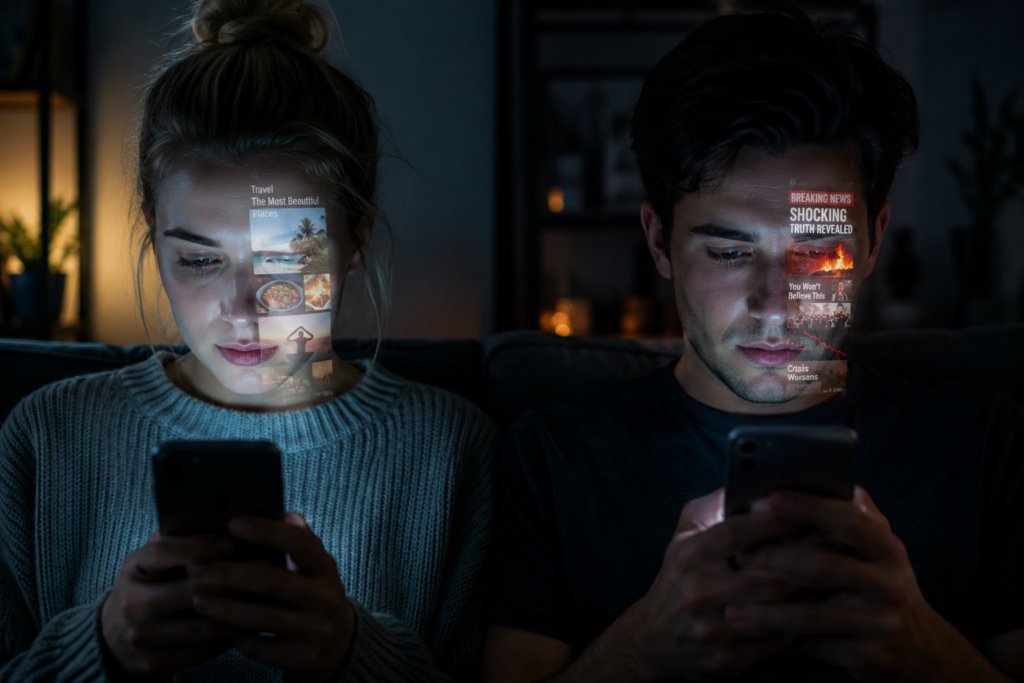
Two people can open the same platform, search for the same topic, and still experience completely different versions of reality.
One person sees outrage. Another sees entertainment. One is pulled toward political conflict. Another is shown lifestyle advice, celebrity drama, financial fear, health claims, or short videos that never seem to end.
Both believe they are simply “using the internet.” But increasingly, they are not seeing the internet itself. They are seeing a version of it selected, ranked, predicted, and personalized for them.
This is one of the most important changes in modern digital life. The internet has not disappeared. But the idea of a shared internet – the same open information space for everyone – is slowly breaking apart.
QUOTE BLOCK:
We no longer only search the internet. The internet now studies us, predicts us, and rearranges itself around us.
This does not mean every platform is secretly controlled by a single hidden hand. The reality is more ordinary, more technical, and in some ways more powerful: most major platforms are built to predict what will keep people engaged.
And when engagement becomes the organizing principle of information, visibility itself becomes a form of power.
How Algorithms Shape What You See Online
For much of the early web, the internet felt more like a collection of places. People visited websites. Search engines returned lists of links. Forums had fixed threads. Blogs had archives. Social media feeds, in their earliest form, were often chronological.
That world was never perfectly neutral. Search engines ranked results. Websites competed for attention. Media companies shaped narratives. But compared with today, the experience was less aggressively individualized.
Today, the internet is increasingly built around feeds, recommendations, ranking systems, and machine learning models. TikTok’s For You feed, YouTube’s homepage recommendations, Facebook Feed ranking, Instagram Explore, Google Discover, and many other systems do not merely display information. They actively select and order it.
TikTok openly explains that its For You system ranks content using user activity, interests, watch behavior, and engagement signals.
SOURCE:
https://newsroom.tiktok.com/en-us/how-tiktok-recommends-videos-for-you
YouTube similarly explains that recommendations are personalized and designed to help users discover videos they are most likely to watch.
SOURCE:
https://www.youtube.com/howyoutubeworks/recommendations/
Meta’s Transparency Center also explains that Facebook Feed uses machine learning systems to rank content for billions of users.
SOURCE:
https://transparency.meta.com/features/ranking-and-content/
KEY TAKEAWAY:
The modern internet is not mainly organized by time. It is organized by prediction: what a platform believes you are most likely to watch, click, react to, or continue scrolling through.
What Personalization Actually Means
Personalization sounds harmless. In many cases, it is useful. People do not want irrelevant content all the time. A good recommendation can help someone discover a useful article, a talented creator, or an important topic they might otherwise never encounter.
But personalization becomes more complicated when it affects news, politics, health, identity, public debate, and emotional perception.
Every click, pause, replay, like, comment, share, search, follow, and watch session becomes a signal. Platforms use those signals to estimate what you may do next.
That means your internet experience is shaped not only by what you consciously choose, but also by what you impulsively react to.
A person may not truly want to live inside a feed full of anger. But if anger keeps them watching, the system may learn that anger works.
TABLE IDEA:
System: Social media feeds
Signals: Likes, comments, shares, time spent
Effect: Feeds become emotional mirrors of past behavior
System: Video recommendations
Signals: Watch time, replays, subscriptions
Effect: Recommendation loops shape viewing habits
System: Search ranking
Signals: Relevance, authority, freshness
Effect: Ranking influences perceived credibility
System: Advertising systems
Signals: Interests, browsing behavior
Effect: Different people receive different realities and messages
The result is not one internet. It is millions of individualized information environments, constantly adjusted in real time.
Algorithms Are Not Neutral
Algorithms are often described as objective machines. But no ranking system is neutral. Every system is built around goals.
Those goals may include relevance, entertainment, safety, ad performance, retention, engagement, or user satisfaction.
The problem is that these goals can conflict.
A calm and nuanced article may be more accurate than an angry viral post. But the angry post may generate more reactions. A sensational claim may spread faster than a careful explanation.
This is not just theory.
A major study published in Science and discussed by MIT found that false news spread farther, faster, deeper, and more broadly than true news on Twitter.
SOURCE:
https://news.mit.edu/2018/study-twitter-false-news-travels-faster-true-stories-0308
SOURCE:
https://www.science.org/doi/10.1126/science.aap9559
The lesson is not that everything online is false. The lesson is that human attention is not evenly distributed. Fear, novelty, outrage, identity, and conflict naturally attract stronger reactions.
QUOTE BLOCK:
If a platform rewards whatever keeps people engaged, it may unintentionally reward the content that most strongly activates human emotion.
This is why conversations about algorithms should not focus only on code. The code matters. But the incentives behind the code matter just as much.
Visibility Is Power
In the digital age, visibility is power.
Visibility decides what people notice, what they discuss, what they fear, what they trust, and what they ignore.
A story does not need to be officially banned to become invisible. Sometimes it only needs to stop appearing in recommendations.
A creator does not need to be deleted to lose influence. Sometimes their reach simply declines.
A public issue does not need to be censored outright to disappear from attention. Sometimes it is buried beneath more engaging content.
This is where modern censorship debates become complicated.
People often imagine censorship as a dramatic act: a book banned, a video removed, an account deleted.
Those things still happen. But many visibility decisions today are softer, quieter, and harder to detect.
Modern platforms can shape distribution through recommendation systems, ranking, demonetization, labeling, downranking, search visibility, and discoverability limits.
Some of these systems are necessary to fight spam, abuse, scams, or harmful content. But they also create enormous power over attention itself.
KEY QUESTION:
When a platform does not delete content, but makes it significantly harder to discover, is that moderation, ranking, safety – or a new form of invisible editorial power?
Two People, Two Different Realities
Imagine two users searching for information about the same public issue.
The first user has previously watched videos criticizing institutions, spent time in angry comment sections, and clicked emotionally charged posts.
The second user mostly follows educational channels, mainstream news, and neutral explainers.
Even if they open the same platform and type similar words, their digital environment may feel entirely different.
One may see dramatic warnings. Another may see institutional explanations.
One may feel that “everyone is talking about this.” Another may barely encounter the topic at all.
Neither person has to be stupid. Neither has to be malicious.
They may simply be living inside different ranked information environments.
This is how parallel digital realities form. Not always through direct deception, but through repeated exposure to different versions of what appears important.
Over time, this changes perception itself.
People begin to experience different emotional versions of reality.
The Emotional Architecture of the Feed
The modern feed is not simply a list of content. It is an emotional architecture.
It decides pacing. It decides contrast. It decides repetition. It decides whether outrage is followed by more outrage or interrupted by something calming.
This matters because humans do not process information rationally all the time. We process it through emotion, identity, stress, memory, belonging, fear, and mood.
A person who sees one extreme post may dismiss it.
A person who sees twenty similar posts in one evening may begin to feel that the world itself has changed.
That is the psychological power of repetition.
Recommendation systems can create the feeling that something is everywhere – even when it is mostly everywhere inside one person’s feed.
QUOTE BLOCK:
The feed does not only show what is happening. It can change what “happening” feels like.
Platform Transparency And Official Explanations
One reason this discussion should not be dismissed as conspiracy theory is that platforms openly describe many parts of these systems themselves.
TikTok openly explains that its For You feed reflects signals unique to each user.
SOURCE:
https://newsroom.tiktok.com/en-us/how-tiktok-recommends-videos-for-you
YouTube explains that recommendations are personalized and designed to help users discover content.
SOURCE:
https://blog.youtube/inside-youtube/on-youtubes-recommendation-system/
Meta explains that Facebook Feed uses machine learning systems to predict what users may find valuable and relevant.
SOURCE:
https://transparency.meta.com/features/explaining-ranking/fb-feed/
These systems are not imaginary.
They are the infrastructure of modern digital life.
Recommended Resources And Videos
Center for Humane Technology:
https://www.humanetech.com/
YouTube Recommendations Explanation:
https://www.youtube.com/howyoutubeworks/recommendations/
Meta Transparency Center:
https://transparency.meta.com/features/ranking-and-content/
TikTok Recommendation System:
https://newsroom.tiktok.com/en-us/how-tiktok-recommends-videos-for-you
VIDEO EMBED IDEA:
Embed one short explainer video somewhere in the middle of the article rather than placing everything at the end. It improves pacing and keeps readers engaged during a long-form feature.
Why This Matters Beyond Technology
This is not only a technology story.
It is a social story, a psychological story, and increasingly a political story.
When people no longer see the same information environment, they lose the ability to understand why others think differently.
One person may genuinely believe a topic is everywhere.
Another may genuinely feel it barely exists.
People then begin assuming others are irrational, manipulated, malicious, or blind.
Sometimes that may be true.
But sometimes they are simply reacting to different informational realities.
That is what makes the fragmentation of the internet so serious.
It does not only divide opinions.
It divides perception itself.
What Users Can Actually Do
No individual can fully escape algorithmic systems. But people can become more aware of them.
Useful habits include:
- Checking the same topic across multiple sources
- Separating intentional searching from endless scrolling
- Using chronological feeds where possible
- Pausing before sharing emotionally charged content
- Reviewing recommendation settings
- Following primary sources directly
- Noticing emotional patterns created by feeds
PRACTICAL TAKEAWAY:
The goal is not to distrust everything online.
The goal is to understand that what appears in front of you is selected – and selection shapes perception.
What Platforms Should Explain More Clearly
Platforms should provide clearer explanations about:
- why specific content is recommended
- when content has been downranked
- how political and news content is treated
- how recommendation systems handle emotionally extreme material
- how users can reset personalization
- how independent researchers can study platform effects
Transparency does not require revealing every anti-spam system.
But there is a difference between protecting a platform and leaving the public unable to understand how visibility is governed.
When a handful of companies mediate the attention of billions of people, “trust us” is not enough.
The Real Question
The real issue is not whether algorithms should exist.
At internet scale, ranking systems are unavoidable.
The deeper question is:
Who controls visibility, according to what incentives, with what transparency, and with what accountability?
Visibility decides which voices grow.
Visibility decides which stories spread.
Visibility decides which problems feel urgent and which quietly disappear.
That makes visibility one of the most important forms of power in the modern world.
QUOTE BLOCK:
The future of free expression may not be decided only by what people are allowed to say, but by what systems allow others to see.
Final Thoughts
The internet did not become personalized overnight.
It happened gradually – feature by feature, recommendation by recommendation, feed by feed.
At first, personalization felt convenient.
Then it became normal.
Now it shapes the way billions of people encounter reality itself.
Two people can sit in the same room, open the same app, and enter entirely different worlds.
That should concern anyone who cares about public debate, journalism, free expression, digital rights, or democracy itself.
The point is not to panic.
The point is to notice.
Because once visibility becomes personalized, ranked, optimized, and quietly controlled by systems most people never see, the old question – “Is information available?” – is no longer enough.
The deeper question becomes:
Will people ever see it?
Submit your story here
If you have evidence of censorship, deplatforming, blocked access, or media suppression, send your article, documentation, or video-based story for review. Submit Your Story