


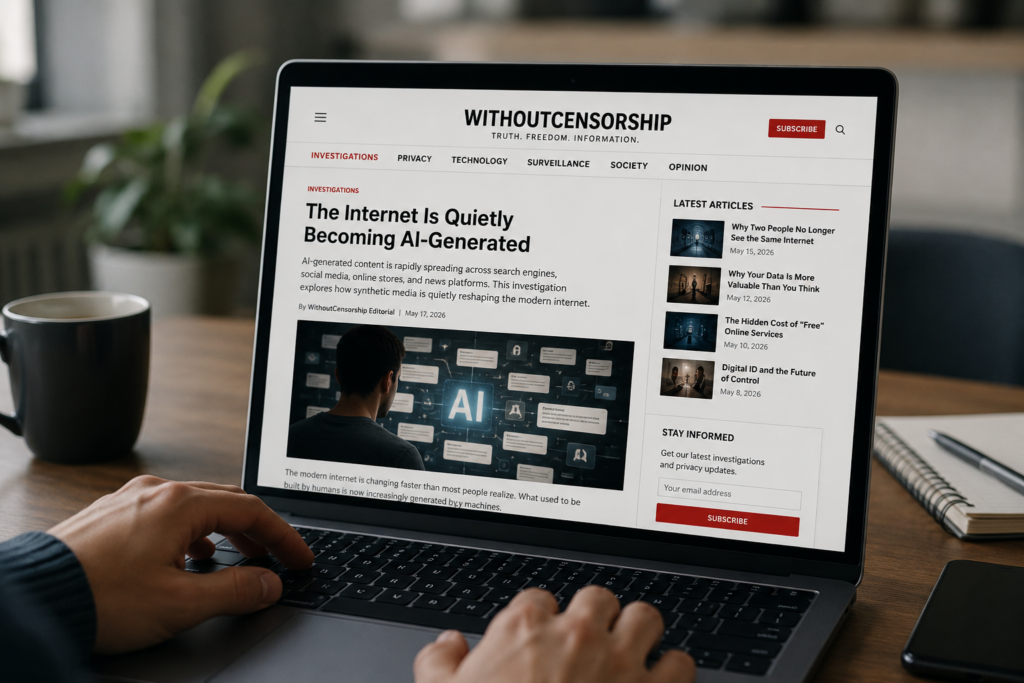
Investigations / Artificial Intelligence / Digital Authenticity
A few years ago, AI-generated content still felt experimental.
People could usually recognize it.
The images looked strange. The writing felt robotic. Videos were awkward. AI chatbots made obvious mistakes. Most synthetic content still carried a certain artificial feeling that separated it from human work.
That line is starting to disappear.
Today, millions of people scroll through content every day without knowing whether it was created by a human being, an AI system, or a combination of both.
Articles.
Product reviews.
Social media posts.
Images.
Videos.
Comments.
News summaries.
Advertising copy.
Even entire websites.
The modern internet is quietly filling with synthetic content at a scale that most people still do not fully realize.
And the shift is happening much faster than many expected.
This is not a conspiracy theory. It is not science fiction. It is already visible across search engines, social media platforms, online marketplaces, advertising systems, and content farms.
The internet is increasingly becoming a place where humans and machines create content together, often indistinguishably.
The deeper question is not whether AI-generated content exists.
It already does.
The real question is this:
What happens to the internet when synthetic content becomes more common than human expression?
AI content is already everywhere
How the AI Generated Internet Is Changing Online Reality
Most people still imagine AI-generated content as rare or experimental.
In reality, it has already become deeply embedded into the online ecosystem.
Large language models can now generate:
- articles
- social media posts
- summaries
- product descriptions
- reviews
- marketing copy
- scripts
- headlines
- comments
- chatbot conversations
Image generators can create:
- portraits
- landscapes
- advertisements
- fake photographs
- illustrations
- influencers
- news-style visuals
Video systems are improving rapidly as well.
Companies including OpenAI, Google, Meta, Runway, and others are investing heavily in generative AI systems capable of producing increasingly realistic media.
OpenAI’s ChatGPT became one of the fastest-growing consumer applications in history after launch.
SOURCE:
https://openai.com/chatgpt
Google has integrated generative AI features into Search.
SOURCE:
https://blog.google/products/search/generative-ai-search/
Meta openly describes AI-generated content tools across its platforms.
SOURCE:
https://ai.meta.com/
Adobe now includes generative AI systems directly inside creative workflows.
SOURCE:
https://www.adobe.com/sensei/generative-ai/firefly.html
This is no longer niche technology.
It is becoming infrastructure.
The economic incentive is obvious
AI-generated content is not spreading only because the technology is impressive.
It is spreading because it is economically useful.
Human content is expensive.
Writers cost money.
Designers cost money.
Editors cost money.
Photographers cost money.
Researchers cost money.
Video production costs money.
AI systems dramatically reduce production costs.
A single person can now generate:
- dozens of articles
- hundreds of images
- thousands of product descriptions
- endless SEO pages
- automated social posts
in a fraction of the time previously required.
For many businesses, the temptation is obvious.
Why hire ten writers when AI can generate massive amounts of content instantly?
Why pay for original photography when AI can create visuals in seconds?
Why spend days brainstorming ad copy when a model can generate hundreds of variations immediately?
This does not necessarily mean companies are malicious.
It means incentives matter.
And the internet has always been heavily shaped by incentives.
Search engines are already struggling with AI content
One of the clearest signs of this shift is visible inside search results.
Many users have started noticing something strange over the last two years.
Search quality often feels worse.
Pages feel repetitive.
Articles feel generic.
Advice sounds recycled.
Many websites appear designed primarily to rank in search engines rather than genuinely help readers.
Part of this problem existed long before generative AI. SEO spam and low-quality content farms have existed for years.
But generative AI dramatically accelerated the scale.
Now, low-cost content production can happen almost infinitely.
Google itself has acknowledged the rise of AI-generated spam and scaled content abuse.
SOURCE:
https://developers.google.com/search/blog/2024/03/core-update-spam-policies
The company has repeatedly updated search systems to reduce low-quality AI content and mass-produced pages designed primarily to manipulate rankings.
But the problem is difficult.
Because not all AI-generated content is bad.
And not all human-written content is good.
The internet is entering a strange new phase where authenticity itself becomes harder to measure.
The web is becoming flooded with synthetic text
Many AI-generated articles now follow similar patterns:
- broad introductions
- repetitive structure
- generic transitions
- emotionally flat language
- predictable conclusions
- keyword-heavy phrasing
People are starting to recognize the feeling even when they cannot fully explain it.
The content feels technically correct, but emotionally empty.
Informative, but strangely lifeless.
This creates a growing concern:
If the internet becomes dominated by synthetic content optimized for engagement and SEO, does the web slowly lose its human texture?
Reddit’s rise reveals something important
One of the most interesting shifts in recent years is that many users increasingly add the word “Reddit” to Google searches.
For example:
- best laptop Reddit
- honest product review Reddit
- anxiety advice Reddit
- real experience Reddit
Why?
Because many users trust human discussion more than SEO-optimized content farms.
Reddit still feels messy, emotional, imperfect, and human.
That matters.
The popularity of human conversation platforms may partly reflect growing distrust toward polished, automated, mass-produced content.
Google itself signed a major licensing agreement with Reddit related to AI training and data access.
SOURCE:
https://blog.google/inside-google/company-announcements/google-reddit-content-partnership/
That partnership reflects how valuable authentic human discussion has become in the AI era.
The internet is slowly losing friction
One of the reasons AI-generated content spreads so quickly is because the internet rewards scale.
The faster content can be produced, the more material platforms can feed into algorithms.
AI removes friction from production.
A person no longer needs:
- strong writing ability
- design skills
- research experience
- photography knowledge
- editing expertise
to generate large amounts of convincing material.
This democratizes creation in some ways.
But it also floods the internet with synthetic volume.
And volume changes ecosystems.
AI-generated images are becoming difficult to detect
Image generation systems improved with shocking speed.
A few years ago, AI-generated hands looked distorted. Faces looked unnatural. Lighting felt strange.
Today, many generated images are visually convincing enough to fool ordinary users.
AI-generated influencers already exist.
AI-generated fashion photography exists.
AI-generated marketing campaigns exist.
AI-generated political images exist.
AI-generated fake news visuals exist.
Some platforms now require labels for AI-generated political advertising or manipulated media.
But enforcement remains inconsistent.
The line between authentic photography and synthetic imagery is becoming increasingly blurred.
Deepfakes are no longer a futuristic problem
Deepfake technology has advanced rapidly.
Researchers, journalists, and policymakers increasingly warn about synthetic audio and video manipulation.
The World Economic Forum has identified AI-driven misinformation as a major global concern.
SOURCE:
https://www.weforum.org/reports/global-risks-report-2024/
Deepfake scams have already affected businesses and individuals.
Fake celebrity advertisements spread online regularly.
Synthetic political clips circulate during election cycles.
Voice cloning systems can imitate real people with alarming realism.
This does not mean all media becomes fake overnight.
But it does mean trust becomes more fragile.
The internet was already optimized for engagement before AI
This is important.
AI did not create the modern attention economy.
It entered an ecosystem already optimized for:
- clicks
- engagement
- retention
- virality
- emotional reactions
That combination matters.
Because AI systems can now generate enormous amounts of emotionally optimized content at scale.
Outrage headlines.
Fear-driven posts.
Polarizing political content.
Emotionally manipulative thumbnails.
Synthetic controversy.
The internet already rewarded emotional intensity.
AI simply makes producing it easier and cheaper.
Bots are becoming harder to recognize
Automated accounts are not new.
But generative AI significantly improves how convincing bots can appear.
AI systems can now:
- imitate conversational tone
- generate realistic comments
- respond dynamically
- mimic human slang
- produce endless variations of text
This creates major concerns for:
- elections
- political discourse
- misinformation
- fake engagement
- manipulation campaigns
The challenge is not only fake information.
It is synthetic participation.
If large numbers of online interactions become automated, public perception itself can be manipulated.
People may begin reacting not to genuine social consensus, but to artificially amplified behavior.
The “Dead Internet Theory” became popular for a reason
The so-called “Dead Internet Theory” is often exaggerated and highly speculative.
Some versions claim most online activity is already fake or bot-driven.
There is little evidence supporting the most extreme versions of the theory.
But the idea became popular because many users genuinely feel that the internet has changed.
People increasingly describe the web as:
- repetitive
- synthetic
- emotionally empty
- commercially manipulated
- algorithmically optimized
The emotional feeling behind the theory matters more than the literal claim.
Many users sense that the internet no longer feels fully human.
And AI acceleration intensifies that feeling.
AI-generated content is not always harmful
This is important to say clearly.
Generative AI also has enormous positive potential.
It can help:
- small creators
- disabled users
- non-native speakers
- researchers
- educators
- artists
- developers
- businesses
AI tools can increase productivity dramatically.
They can help people brainstorm ideas, organize information, summarize research, and communicate more effectively.
Some AI-generated educational content is genuinely useful.
Some AI-assisted creative work is impressive.
The issue is not whether AI should exist.
The issue is what happens when synthetic content becomes overwhelming in scale.
Authenticity may become the internet’s most valuable resource
As AI-generated material increases, human authenticity may become more valuable.
Real expertise.
Real experience.
Real photography.
Real reporting.
Real interviews.
Real communities.
Real discussion.
Ironically, the rise of synthetic content may increase demand for genuinely human spaces.
This may partly explain why:
- newsletters are growing
- podcasts feel more trusted
- direct creator communities matter more
- live content feels valuable
- human imperfections feel reassuring
People increasingly search for signs that something was created by a real person.
Even human creators are starting to sound algorithmic
One subtle effect of AI systems is that humans themselves may adapt toward machine-optimized behavior.
Writers optimize headlines for clicks.
Creators imitate algorithmic pacing.
YouTubers copy retention patterns.
TikTok creators follow engagement formulas.
Businesses mass-produce “optimized” content.
The internet slowly becomes standardized around whatever performs best inside recommendation systems.
That can create a strange flattening effect.
Content becomes technically optimized but emotionally repetitive.
AI search summaries may reshape the web economy
Google and other companies increasingly integrate AI-generated summaries directly into search experiences.
This creates a major economic concern for publishers.
If AI systems summarize content directly inside search interfaces, fewer users may visit original websites.
Publishers, journalists, bloggers, and independent creators worry this could reduce traffic dramatically.
Some fear the internet may evolve toward:
- fewer independent sites
- more centralized AI platforms
- less direct discovery
- declining incentives for original publishing
This issue is still evolving.
But it could fundamentally reshape the economics of the web.
The internet is entering an authenticity crisis
For years, the internet struggled with misinformation.
Now it faces another challenge:
Synthetic abundance.
Not all fake content is politically motivated.
Sometimes it is simply generated because scale is profitable.
Cheap articles.
Cheap engagement.
Cheap traffic.
Cheap images.
Cheap authority.
The danger is not only false information.
The danger is informational exhaustion.
Users become overwhelmed.
Trust declines.
Everything begins feeling slightly artificial.
And once trust collapses, rebuilding it becomes difficult.
Young users may grow up in partially synthetic environments
This may become one of the biggest long-term consequences.
Future generations may spend enormous portions of life interacting with:
- AI-generated media
- AI-generated personalities
- AI-generated assistants
- AI-generated entertainment
- AI-generated conversations
Some of these systems may become emotionally sophisticated enough to simulate companionship convincingly.
That raises deep social questions:
- What happens to human relationships?
- What happens to trust?
- What happens to identity?
- What happens to authenticity?
The internet may become less about accessing human expression and more about navigating synthetic systems designed to imitate it.
Platforms have strong incentives to continue
This is why the shift will likely accelerate.
AI-generated content reduces costs.
More content increases engagement opportunities.
More engagement increases advertising opportunities.
The incentives align.
And most users still prioritize:
- convenience
- speed
- entertainment
- free access
over deeper concerns about authenticity.
That makes resistance difficult.
Some platforms are already responding
Major companies increasingly discuss:
- AI labeling
- synthetic media disclosure
- watermarking
- authenticity standards
- content provenance systems
The Coalition for Content Provenance and Authenticity (C2PA) is one example of industry efforts attempting to track media origins.
SOURCE:
https://c2pa.org/
But solving authenticity at internet scale is extremely difficult.
Especially once synthetic media becomes nearly indistinguishable from reality.
Human creativity is not disappearing
Despite all this, human creativity still matters deeply.
People still crave:
- real stories
- genuine emotion
- lived experience
- personality
- vulnerability
- imperfection
AI can imitate patterns.
But many people still recognize something different in genuinely human work.
The challenge is whether human work remains visible inside systems increasingly flooded with synthetic material.
Visibility matters.
And visibility online is increasingly shaped by algorithms.
What users can actually do
No individual user can stop the rise of AI-generated content.
But people can become more aware of the environment they inhabit.
Useful habits include:
- checking sources carefully
- following trusted creators directly
- valuing primary reporting
- supporting human journalism
- questioning emotionally manipulative content
- recognizing engagement farming
- paying attention to repetitive language patterns
- using multiple information sources
- slowing down before sharing viral material
The goal is not paranoia.
The goal is awareness.
Final Thoughts
The internet is not becoming entirely fake.
But it is becoming increasingly synthetic.
And that distinction matters.
AI-generated content will continue growing because the economic incentives are enormous and the technology is improving rapidly.
Some of this transformation will be useful.
Some of it will be creative.
Some of it will genuinely help people.
But some of it may slowly erode trust, authenticity, and human connection online.
The internet once felt like a place where humans expressed themselves directly.
Now it increasingly feels like a place where algorithms, optimization systems, and generative models shape what becomes visible.
The deeper question is no longer whether AI content exists.
It already surrounds us.
The real question is whether future users will still be able to recognize what is genuinely human in a digital world increasingly filled with synthetic voices.
Sources And Further Reading
OpenAI ChatGPT:
https://openai.com/chatgpt
Google Search Generative AI:
https://blog.google/products/search/generative-ai-search/
Google spam policy updates:
https://developers.google.com/search/blog/2024/03/core-update-spam-policies
Meta AI:
https://ai.meta.com/
Adobe Firefly:
https://www.adobe.com/sensei/generative-ai/firefly.html
Google and Reddit partnership:
https://blog.google/inside-google/company-announcements/google-reddit-content-partnership/
World Economic Forum Global Risks Report:
https://www.weforum.org/reports/global-risks-report-2024/
Coalition for Content Provenance and Authenticity:
https://c2pa.org/
Submit your story here
If you have evidence of censorship, deplatforming, blocked access, or media suppression, send your article, documentation, or video-based story for review. Submit Your Story