


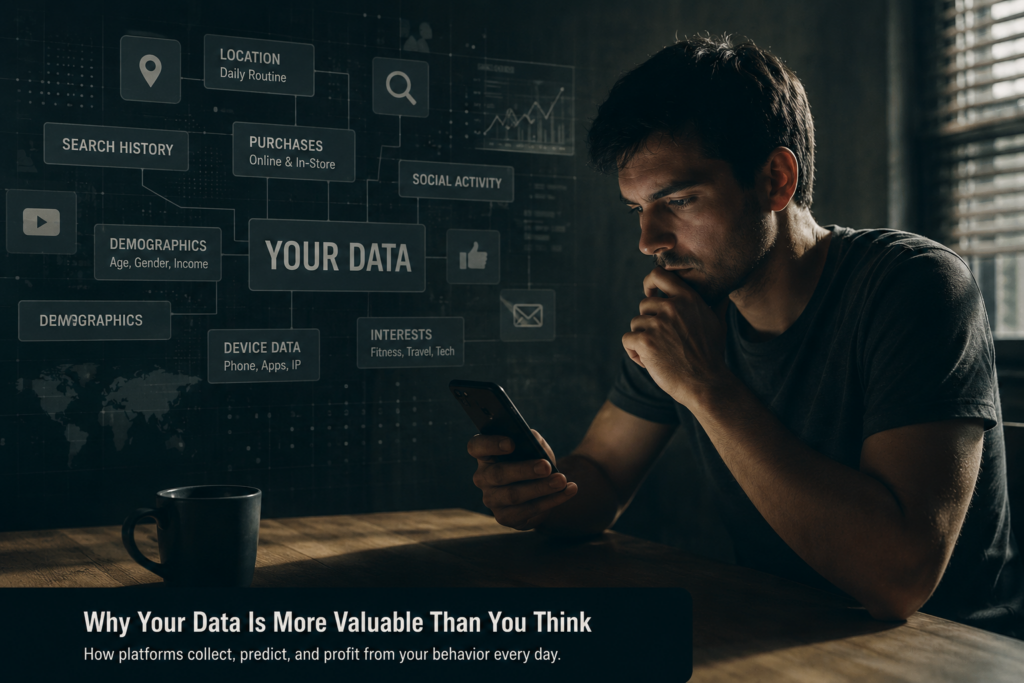
Investigations / Data Collection & Digital Power
Most people do not think of themselves as products.
They think they are users.
They open apps, scroll through feeds, watch videos, search for information, message friends, check maps, browse online stores, and move through the internet as if they are simply consuming digital services.
But behind almost every major platform is another reality – one that most people rarely see directly.
Modern digital platforms are not only interested in what users click. Increasingly, they are interested in predicting what users will do next.
That prediction business is now one of the most powerful economic systems on Earth.
And prediction requires data.
Not just basic data.
Behavioral data.
Emotional data.
Attention data.
Pattern data.
The internet no longer simply responds to people. It studies them.
The most valuable resource of the digital age may not be oil – but human behavior
For years, people repeated the phrase:
“Data is the new oil.”
The comparison was imperfect, but it captured something important.
The world’s largest technology companies became extraordinarily valuable not only because they built software, but because they built systems capable of collecting, organizing, analyzing, and monetizing human behavior at enormous scale.
Google built one of the most profitable advertising systems in history.
Meta transformed social interaction into behavioral targeting infrastructure.
TikTok created one of the most addictive recommendation systems ever designed.
Amazon turned shopping behavior into predictive commerce.
These companies are not identical. Their systems differ. Their incentives differ. Their platforms differ.
But they share one fundamental principle:
The more accurately a platform can predict human behavior, the more economically valuable that platform becomes.
Most data collection does not look dramatic
People often imagine data collection as something extreme.
A hacker.
A surveillance room.
A microphone secretly recording conversations.
Those things can happen. But most modern data collection is far less cinematic – and far more ordinary.
It happens quietly through normal digital life.
Everyday actions become signals.
A pause while scrolling.
A late-night search.
A video replayed twice.
A product viewed but not purchased.
A topic searched repeatedly during stressful hours.
A sudden interest in health symptoms.
A sequence of emotional reactions.
Individually, these signals may seem meaningless.
At scale, they become patterns.
And patterns are valuable.
Platforms do not only track what you say – they track what holds your attention
One of the most important shifts in the modern internet is this:
Platforms increasingly care less about what users claim to want and more about what users consistently react to.
This distinction matters enormously.
A user may say they value balanced information.
But if outrage keeps them scrolling longer, outrage becomes economically useful.
A user may say they dislike sensationalism.
But if sensational content generates stronger engagement signals, algorithms learn that sensationalism performs well.
This is why modern recommendation systems are so powerful.
They are not simply responding to explicit preferences.
They are learning from behavior itself.
Your attention is measurable
Many users still think of attention as abstract.
But modern digital systems increasingly measure attention in extraordinary detail.
Examples can include:
- watch time
- scroll speed
- click timing
- hover duration
- pauses
- repeat viewing
- engagement patterns
- search sequences
- interaction frequency
- session length
- navigation behavior
This does not mean every company tracks every possible signal equally.
But attention itself has become measurable data.
And measurable attention can be optimized.
Why recommendation systems need enormous amounts of data
Recommendation systems are now central to modern digital platforms.
TikTok’s For You feed.
YouTube recommendations.
Instagram Explore.
Facebook Feed ranking.
Spotify recommendations.
Netflix suggestions.
Amazon product recommendations.
These systems rely heavily on behavioral data because recommendation quality depends on prediction quality.
TikTok openly explains that its recommendation system uses signals such as user interactions, video information, and device settings.
SOURCE:
https://newsroom.tiktok.com/en-us/how-tiktok-recommends-videos-for-you
YouTube similarly explains that recommendations are personalized based on viewing behavior and user activity.
SOURCE:
https://www.youtube.com/howyoutubeworks/recommendations/
Meta’s Transparency Center explains that Facebook Feed uses machine learning systems to predict which content users may find valuable or relevant.
SOURCE:
https://transparency.meta.com/features/ranking-and-content/
This is not hidden.
The systems themselves are openly acknowledged.
What many users underestimate is the scale.
Billions of interactions.
Billions of behavioral signals.
Constantly processed in real time.
The internet increasingly builds psychological profiles
Most people imagine profiles as simple categories:
male or female
young or old
sports fan
technology enthusiast
But modern behavioral systems can become far more complex than traditional demographic labels.
Patterns reveal emotional tendencies.
Attention habits.
Impulse behavior.
Stress cycles.
Political interest.
Financial anxiety.
Sleep disruption.
Identity patterns.
Lifestyle preferences.
Vulnerability to specific messaging.
No system understands a human being perfectly.
But systems do not need perfect understanding to become extremely effective.
Prediction does not require complete knowledge.
It only requires enough probability to influence outcomes.
A frightening amount can be learned from small signals
Researchers have repeatedly shown that seemingly minor behavioral data can reveal surprisingly personal information.
Location patterns can reveal routines.
Purchase history can reveal life changes.
Browsing habits can reveal emotional states.
Search history can reveal fears, symptoms, insecurities, interests, or political curiosity.
Even timing patterns matter.
A user searching financial anxiety topics at 2:00 AM may represent a very different psychological context than a casual daytime search.
A user repeatedly replaying emotionally charged videos sends strong engagement signals.
A user lingering on conflict-oriented content may influence future recommendations.
The system learns continuously.
Sometimes more quickly than users realize.
People often believe they are making free choices
And in many ways, they are.
Users still choose what to click.
What to watch.
What to follow.
What to ignore.
But digital environments increasingly shape the probability of those choices.
Recommendation systems influence exposure.
Exposure influences familiarity.
Familiarity influences trust.
Trust influences belief.
Belief influences behavior.
This does not mean humans become robots controlled by algorithms.
Reality is more subtle than that.
But subtle influence at enormous scale becomes historically significant.
The business model behind the modern internet
Many internet services appear free.
Social media.
Video platforms.
Search engines.
Recommendation feeds.
News aggregation.
Messaging ecosystems.
But operating these systems globally costs enormous amounts of money.
Servers.
Infrastructure.
AI systems.
Moderation.
Cloud computing.
Development.
Advertising became the dominant solution.
And advertising performs better when targeting becomes more accurate.
More accurate targeting requires more behavioral understanding.
Behavioral understanding requires more data.
This creates a powerful incentive cycle.
Why advertisers value prediction so highly
Traditional advertising was broad.
A television commercial reached millions of people at once.
Most viewers were irrelevant.
Digital advertising changed that model.
Modern systems can target:
- age groups
- interests
- shopping behavior
- location
- browsing patterns
- device usage
- engagement history
- probable interests
- likely purchasing intent
The goal is not merely showing ads.
The goal is predicting responsiveness.
Who is most likely to click?
Who is most likely to buy?
Who is emotionally receptive at a specific moment?
Who is vulnerable to a specific message?
That predictive capability is enormously valuable economically.
The attention economy changes platform behavior
When attention becomes monetizable, platforms naturally compete for it.
This changes internet design itself.
Platforms optimize:
- retention
- session duration
- engagement
- emotional intensity
- repeat usage
- compulsive return behavior
This is one reason infinite scroll became so widespread.
It removes stopping points.
One video becomes another.
One recommendation becomes another.
One emotional reaction feeds the next.
The goal is often seamless engagement continuity.
Human psychology was not designed for infinite feeds
Humans evolved in environments with natural stopping points.
Physical limits.
Social limits.
Environmental limits.
Modern feeds increasingly remove those boundaries.
The result can create powerful psychological effects:
- compulsive scrolling
- distorted time perception
- emotional overload
- outrage loops
- anxiety cycles
- information fatigue
- emotional dependency
This does not affect everyone equally.
But platforms increasingly compete in environments where attention itself is the prize.
And systems optimized for engagement do not always optimize for well-being.
Outrage performs extremely well online
This is one of the uncomfortable truths of the modern internet.
Calm information often spreads more slowly than emotionally charged content.
Fear spreads.
Conflict spreads.
Identity-based outrage spreads.
Novelty spreads.
A major study published in Science found that false news spread farther and faster on Twitter than true news within the dataset studied.
SOURCE:
https://www.science.org/doi/10.1126/science.aap9559
MIT’s summary of the research explained that falsehoods often had a novelty advantage and generated stronger reactions.
SOURCE:
https://news.mit.edu/2018/study-twitter-false-news-travels-faster-true-stories-0308
This does not mean everything online is false.
It means emotional activation strongly affects visibility dynamics.
And when visibility becomes economically important, emotionally activating content becomes highly competitive.
Recommendation systems can unintentionally radicalize behavior
This topic remains heavily debated.
Most major platforms reject simplistic claims that algorithms intentionally push extremism.
Reality is more complicated.
But recommendation systems can create reinforcement loops.
A user watches one controversial video.
The system recommends something slightly stronger.
Then something slightly more emotionally engaging.
Then something more identity-confirming.
Not because a human operator necessarily planned it that way – but because the system learned which pathways increase engagement.
Over time, repeated exposure changes perception.
The feed becomes personalized reality
One of the most important changes in modern digital life is that feeds no longer simply reflect the world.
They construct individualized versions of it.
Two users can open the same app and encounter entirely different emotional environments.
One sees conflict.
Another sees entertainment.
One sees political outrage.
Another sees self-improvement advice.
One sees fear-based narratives.
Another barely encounters them at all.
This fragmentation changes society itself.
Because people increasingly disagree not only about opinions – but about what reality even looks like.
Why “free platforms” are rarely truly free
People sometimes say:
“If the product is free, you are the product.”
The phrase is simplistic, but it contains an important insight.
Most large platforms do not primarily sell software access.
They monetize attention, prediction, targeting, and engagement.
Users are not literally products.
But user behavior becomes economically valuable inventory.
The more accurately behavior can be predicted, the more valuable that system becomes.
Data brokers and the hidden ecosystem most users never see
Many people think only social media companies collect data.
But a much larger ecosystem exists behind the scenes.
Data brokers buy, aggregate, combine, and analyze information from multiple sources.
This industry can include:
- location data
- browsing behavior
- app activity
- purchase patterns
- demographic estimates
- advertising identifiers
The Federal Trade Commission has repeatedly examined concerns around commercial surveillance and data practices.
SOURCE:
https://www.ftc.gov/business-guidance/privacy-security/commercial-surveillance
Many users never directly interact with these companies.
Yet their behavioral data may still move through parts of this ecosystem.
Smartphones became behavioral sensors
Modern smartphones collect extraordinary amounts of contextual information.
Location.
Movement.
Usage timing.
App interaction.
Search patterns.
Browsing behavior.
Notification responses.
Again, this does not mean every company accesses every possible signal equally.
Permissions matter.
Policies differ.
Regulations differ.
But smartphones transformed digital tracking into continuous behavioral infrastructure.
Why location data is incredibly sensitive
Location data may be among the most revealing forms of information.
Repeated location patterns can reveal:
- work routines
- home locations
- social habits
- religious attendance
- medical visits
- political participation
- relationship patterns
Even anonymized location datasets have raised major privacy concerns because individuals can sometimes be re-identified through pattern analysis.
This is one reason privacy advocates increasingly warn that location tracking should be treated as highly sensitive information.
AI makes behavioral prediction even more powerful
Artificial intelligence dramatically increases the scale and sophistication of pattern analysis.
Machine learning systems can detect relationships inside enormous datasets that humans could never manually process efficiently.
This improves:
- recommendation systems
- advertising targeting
- content ranking
- predictive modeling
- personalization systems
As AI improves, prediction systems may become even more effective at understanding behavioral tendencies.
That possibility raises difficult ethical questions.
The future may not be mass surveillance – but personalized influence
Traditional surveillance imagined governments watching everyone directly.
The modern digital environment may evolve differently.
Instead of simply observing behavior, systems increasingly shape behavior through personalized environments.
Feeds influence mood.
Recommendations influence curiosity.
Visibility influences attention.
Attention influences perception.
Perception influences decisions.
The result is not always coercion.
Often it is subtle behavioral steering.
And subtle influence at scale can become historically powerful.
Why transparency matters
Most people cannot meaningfully consent to systems they do not understand.
Platforms should explain more clearly:
- why content is recommended
- what signals affect visibility
- how personalization works
- how users can reset recommendations
- how emotionally extreme content is treated
- when content is downranked
- how behavioral targeting operates
Transparency alone will not solve every problem.
But invisible systems operating at global scale create enormous trust challenges.
The problem is not technology itself
Technology is not inherently evil.
Recommendation systems can help users discover valuable information.
Search engines can organize human knowledge.
Social media can connect isolated people.
Video platforms can educate millions.
The issue is not whether digital systems should exist.
The issue is what incentives shape them.
Systems optimized only for engagement may unintentionally optimize for emotional escalation.
Systems optimized only for advertising performance may optimize for psychological manipulation.
The underlying incentives matter enormously.
What users can actually do
No individual can completely escape the modern data economy.
But awareness still matters.
Practical steps include:
- reviewing privacy settings regularly
- limiting unnecessary app permissions
- using privacy-focused browsers where possible
- separating intentional searching from passive scrolling
- following primary sources directly
- clearing recommendation histories periodically
- reducing compulsive feed consumption
- questioning emotionally manipulative content
- understanding that feeds are curated environments, not objective reality
The goal is not paranoia.
The goal is awareness.
The internet studies us because prediction is profitable
This may be the central truth of the modern digital economy.
The internet does not only store information anymore.
It increasingly studies behavior itself.
What captures attention.
What triggers reaction.
What creates fear.
What creates loyalty.
What creates engagement.
And because behavioral prediction became economically valuable, the systems surrounding us became increasingly optimized to learn from us continuously.
Final Thoughts
Most people still think they are simply browsing the internet.
In reality, they increasingly move through environments designed to measure, predict, personalize, and influence behavior.
Not always maliciously.
Not always centrally.
Not always intentionally.
But systematically.
The modern internet is no longer only a communication system.
It is a behavioral ecosystem.
And the more invisible that ecosystem becomes, the more important it is for users to understand it.
Because in the digital age, power does not only belong to whoever controls information.
Increasingly, power belongs to whoever understands human behavior well enough to shape attention itself.
Sources And Further Reading
Google Ads and targeted advertising:
https://support.google.com/google-ads/answer/2453998
TikTok recommendation system:
https://newsroom.tiktok.com/en-us/how-tiktok-recommends-videos-for-you
YouTube recommendations:
https://www.youtube.com/howyoutubeworks/recommendations/
Meta Transparency Center:
https://transparency.meta.com/features/ranking-and-content/
Science study on false news:
https://www.science.org/doi/10.1126/science.aap9559
MIT summary of the study:
https://news.mit.edu/2018/study-twitter-false-news-travels-faster-true-stories-0308
Federal Trade Commission – Commercial Surveillance:
https://www.ftc.gov/business-guidance/privacy-security/commercial-surveillance
Center for Humane Technology:
https://www.humanetech.com/
Electronic Frontier Foundation:
https://www.eff.org/issues/privacy
Mozilla Privacy Not Included:
https://foundation.mozilla.org/en/privacynotincluded/
Submit your story here
If you have evidence of censorship, deplatforming, blocked access, or media suppression, send your article, documentation, or video-based story for review. Submit Your Story