

Censorship • Digital Rights • Privacy
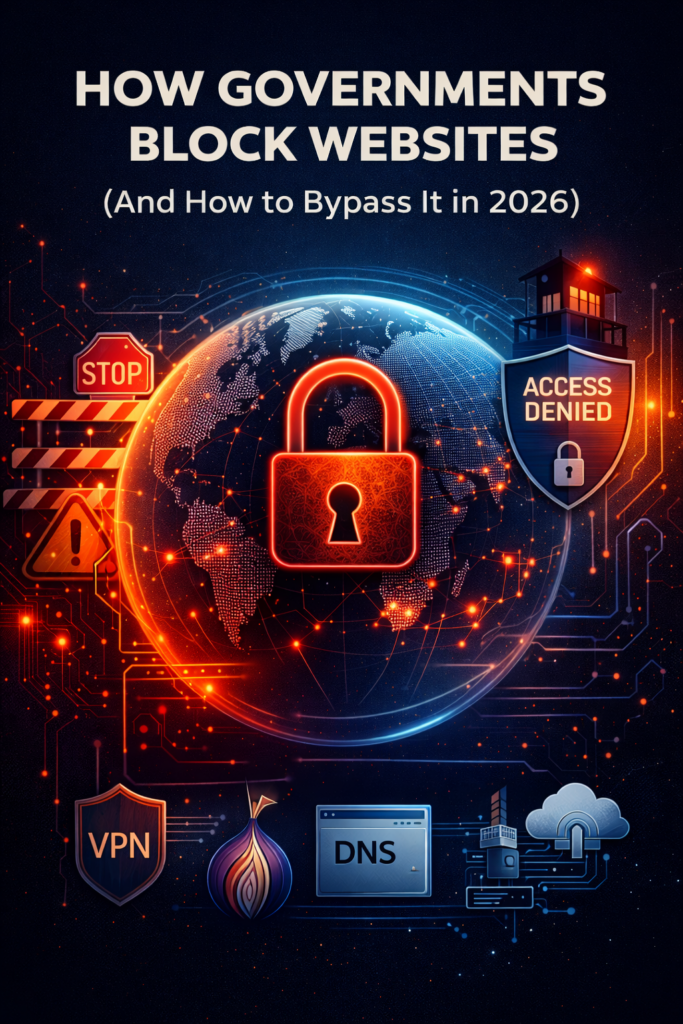
How Governments Block Websites in 2026 (Complete Guide + What Actually Works)
The internet in 2026 is still global — but it is no longer truly open.
Most people believe they have unlimited access to information. They can search, scroll, click, and explore. Everything feels available. Everything feels fast. Everything feels free.
But what if that experience is only partial?
What if what you see online is not the full internet — but a filtered version of it?
This is exactly how modern censorship works.
In the past, blocking a website meant shutting it down completely. Today, it is far more sophisticated. Governments and networks rarely remove content directly. Instead, they interfere with how information is delivered, discovered, and prioritized.
This guide explains how governments block websites in 2026, how these systems operate behind the scenes, and what actually works if you want to access restricted content.
1. How Governments Block Websites: The System Behind the Screen
To understand how governments block websites, you first need to understand how a website loads.
When you enter a URL into your browser, several steps happen instantly:
- Your device asks a DNS server where the website is located
- The DNS server returns an IP address
- Your browser connects to that server
- Data flows between your device and the website
This entire process takes milliseconds.
But each step is a control point.
Governments do not need to “delete” a website. They only need to disrupt one of these steps.
That is why modern censorship is so effective. It operates within the infrastructure itself.
2. DNS Blocking: The Simplest Form of Control
One of the most common methods used to block websites is DNS filtering.
DNS works like a translator. It converts domain names into IP addresses. Without it, you cannot find websites.
When DNS blocking is applied:
- The correct IP address is not returned
- The request fails silently
- The website appears offline
This method is widely used because it is cheap and scalable.
More importantly, it does not look like censorship. It looks like a technical error.
And that is exactly the point.
3. IP Blocking: Direct but Imperfect
Every website is hosted on an IP address. Blocking that address prevents access entirely.
This is more aggressive than DNS blocking, but it is also less precise.
Modern websites often share infrastructure. One IP can host hundreds of domains.
When a government blocks one IP, it may unintentionally block many unrelated websites.
This is called collateral damage.
Despite this, IP blocking remains widely used because of its simplicity.
4. URL and Keyword Filtering: Targeted Censorship
Instead of blocking entire websites, systems can filter specific content.
This includes:
- Specific URLs
- Keywords
- Search queries
This creates a selective experience:
- The homepage works
- Specific articles do not
- Search results are incomplete
This is one of the most powerful forms of censorship because it is almost invisible.
Users rarely realize that what they see is incomplete.
5. Throttling and Connection Interference
Not all censorship blocks access completely.
Sometimes the goal is to make access frustrating.
This is done through:
- Slowing down connections
- Injecting delays
- Randomly dropping packets
To the user, it feels like bad internet.
But in reality, it can be deliberate interference.
This method is extremely effective because it avoids suspicion.
6. Deep Packet Inspection (DPI): The Advanced Layer
Deep Packet Inspection is one of the most advanced tools used to block websites.
Instead of looking only at where traffic is going, DPI analyzes what the traffic is.
It can detect:
- VPN usage
- Tor connections
- Encrypted traffic patterns
This allows networks to block not only websites — but also the tools used to bypass censorship.
For a technical overview, see: Internet censorship explained.
7. How to Tell If a Website Is Actually Blocked
Not every broken site is censored.
Before assuming blocking, test the situation:
- Try a different network (mobile vs WiFi)
- Check access from another country
- Use a public status checker
If the issue is consistent across a specific network or region, censorship is likely involved.
8. What Actually Works in 2026
Many people look for simple solutions.
Unfortunately, most common advice does not work.
Things that do NOT bypass censorship:
- Clearing cookies
- Using incognito mode
- Restarting your router
What actually works depends on the type of block.
Effective methods include:
- Changing DNS providers
- Using a high-quality VPN
- Using Tor with bridges
- Using obfuscation tools
Each method has strengths and limitations.
There is no universal solution.
9. Common Mistakes Users Make
Trusting Free Tools
Free VPNs and “unblocker” apps often collect data.
In many cases, they introduce more risk than protection.
Confusing Access with Privacy
Accessing a site does not mean you are anonymous.
Your identity and activity may still be visible.
Using One Tool for Everything
Different blocks require different solutions.
Using the wrong tool leads to failure.
10. Why Governments Block Websites
Understanding how governments block websites is only part of the picture.
The real question is why.
Common reasons include:
- Political control
- Content regulation
- Information management
In some cases, restrictions are justified.
In others, they are used to shape perception.
The difference is not always obvious.
11. The Changing Nature of the Internet
The internet was originally designed to be decentralized.
Today, it is increasingly controlled by a small number of actors.
This includes:
- Governments
- Technology companies
- Infrastructure providers
As a result, the experience of the internet is becoming more curated.
Users are no longer exploring freely.
They are navigating a filtered environment.
To understand this shift, read: Who controls the internet in 2026.
12. The Illusion of Freedom
Most users believe they are free online.
They can search, scroll, and click without restriction.
But what they see is often shaped by invisible systems.
Algorithms decide visibility.
Platforms decide reach.
Networks decide access.
This creates an illusion of openness.
13. Practical Advice for Users
You do not need to be a technical expert to navigate censorship.
Start with awareness:
- Understand that not all content is visible
- Use multiple sources
- Question what you see
Small changes in behavior can make a significant difference.
14. Frequently Asked Questions
Can governments block all websites?
No, but they can restrict access significantly.
Is VPN enough?
Not always. Advanced systems can detect VPN traffic.
Is bypassing censorship legal?
It depends on your country and local laws.
Related Reading
15. The Psychology Behind Internet Censorship
Understanding how governments block websites is only one part of the story. The deeper layer is psychological.
Modern censorship is not just about removing access. It is about shaping behavior.
When users encounter slow loading, missing pages, or inconsistent results, they adapt. They stop searching. They accept what is available. They trust what appears first.
This creates a powerful effect:
- People stop questioning missing information
- Alternative viewpoints become invisible
- Mainstream narratives dominate by default
This is not forced censorship. It is guided behavior.
And it is far more effective.
16. How Algorithms Amplify Censorship
Even when governments do not directly block websites, algorithms can achieve similar results.
Search engines and social platforms prioritize content based on engagement, authority, and relevance signals.
But these signals are not neutral.
They are influenced by:
- Content moderation policies
- Political pressure
- Commercial incentives
This means certain topics may:
- Rank lower
- Receive less visibility
- Disappear from recommendations
From the user perspective, nothing is “blocked.”
But the result is the same.
This is often referred to as soft censorship.
17. The Role of Internet Service Providers (ISPs)
Internet Service Providers play a critical role in how governments block websites.
They act as intermediaries between users and the internet.
In many countries, ISPs are required to enforce blocking policies.
This can include:
- DNS filtering
- IP blacklists
- Traffic inspection
Because ISPs control the infrastructure, they can implement restrictions efficiently and at scale.
This makes them one of the most powerful actors in the censorship ecosystem.
18. Centralization: The Hidden Weakness of the Internet
The internet was originally decentralized.
But over time, it has become concentrated.
Today, a small number of companies control:
- Search
- Cloud hosting
- Content distribution
This creates a structural vulnerability.
If access points are centralized, control becomes easier.
This is why modern censorship does not require total shutdowns.
It only requires influence over key nodes.
19. The Rise of Decentralized Alternatives
As awareness grows, so does interest in decentralized systems.
These include:
- Blockchain-based platforms
- Peer-to-peer networks
- Distributed hosting systems
The goal is simple:
Remove single points of control.
However, these systems face challenges:
- Scalability
- Usability
- Adoption barriers
They are promising — but not yet mainstream.
20. Legal and Ethical Considerations
Not all censorship is purely negative.
Some restrictions are implemented for:
- Illegal content removal
- Security concerns
- Public safety
The challenge lies in balance.
Where does protection end and control begin?
This is one of the defining questions of the modern internet.
21. Case Studies: Real-World Blocking Scenarios
To fully understand how governments block websites, it helps to look at real-world patterns.
Common scenarios include:
- Temporary blocks during protests or elections
- Permanent bans on specific platforms
- Selective filtering of news sources
In each case, the goal is not always to eliminate access entirely.
Often, it is to control timing, reach, and narrative.
22. The Future of Website Blocking
The methods used to block websites will continue to evolve.
Future trends include:
- AI-driven content filtering
- More advanced traffic fingerprinting
- Integration with identity systems
This will make censorship:
- More precise
- Less visible
- Harder to bypass
At the same time, bypass technologies will also evolve.
This creates an ongoing cycle.
A constant technological arms race.
23. Why Awareness Matters More Than Tools
Most users look for tools.
VPNs, proxies, Tor.
But tools are only part of the solution.
The real advantage is awareness.
If you understand how governments block websites, you can:
- Choose the right solution
- Avoid common mistakes
- Recognize when content is missing
Without awareness, even the best tools are ineffective.
24. A Simple Framework for Understanding Censorship
If you want to simplify everything, think of censorship in three layers:
- Access layer – DNS, IP, infrastructure
- Visibility layer – search, algorithms, ranking
- Behavior layer – user habits and perception
Most people focus only on the first layer.
But the real influence happens across all three.
25. The Role of Media and Information Control
Controlling websites is not just about blocking access.
It is about shaping information flow.
When certain sources are limited, others gain dominance.
This affects:
- Public opinion
- Political narratives
- Global perception
In this sense, censorship is not just technical.
It is strategic.
26. Final Perspective: What This Means for You
Understanding how governments block websites is no longer optional.
It is part of digital literacy.
You do not need to become an expert.
But you should understand the basics:
- The internet is not fully open
- Access can be restricted in multiple ways
- What you see is not always complete
This awareness changes how you interact with information.
It makes you more critical.
More informed.
More independent.
27. Closing Thought
The internet was once a place of pure exploration.
Today, it is a structured environment shaped by systems, rules, and invisible controls.
But it is not lost.
It is still there — beneath the surface.
And those who understand how it works are the ones who can still access it fully.
Because the biggest limitation is not technology.
It is awareness.
Have a real story?
Submit your story here
If you have evidence of censorship, deplatforming, blocked access, or media suppression, send your article, documentation, or video-based story for review. Submit Your Story